Updated on July 27, 2026
Editor: Marco Aurélio Gomes Veado

4 Very Different Brain Conditions: What Can They Teach Us About the Brain?
Marco Aurélio Gomes Veado
4 min read
•
September 14, 2026
Listen to audio version of this article
0:00
0:00
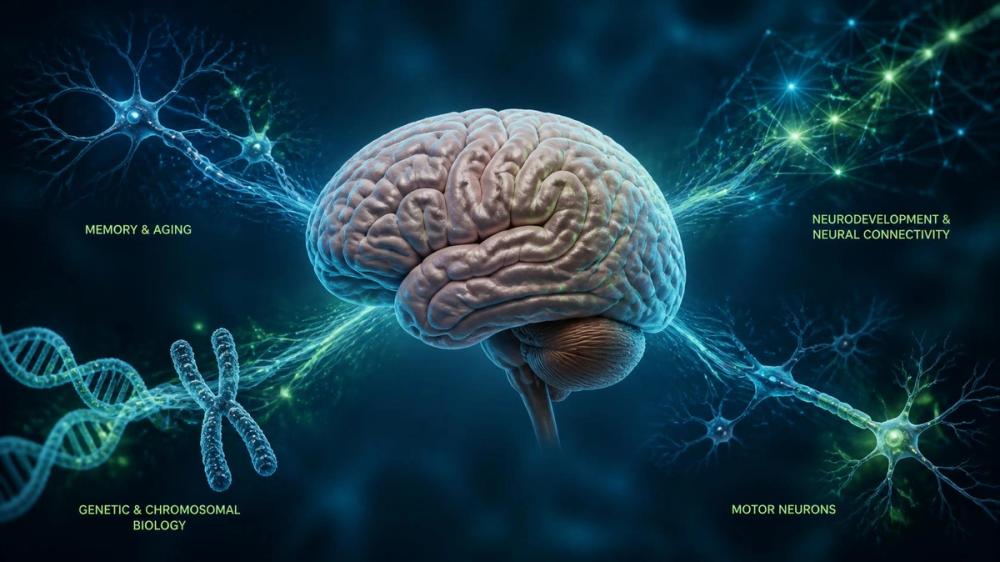
Dementia, autism, Down syndrome, and ALS are often discussed together because they all involve the brain. But scientifically, they are very different conditions.
Autism and Down syndrome are primarily associated with neurodevelopment and genetics. ALS is a progressive neurodegenerative disease affecting motor neurons. Dementia is not one disease but a syndrome caused by different disorders, including Alzheimer’s disease.
Yet, when scientists compare these conditions, fascinating connections emerge.
MCI and Beyond will take a deep dive into these topics.
Different beginnings, overlapping biology
Autism begins during brain development. Researchers have identified hundreds of genetic variations that can contribute to autism, although there is no single “autism gene.” Studies are increasingly examining how these genetic differences influence the development of neural connections and communication between brain cells.
Down syndrome has a much more clearly defined genetic origin: an extra copy of chromosome 21. This chromosome contains the APP gene, which is involved in the production of amyloid-beta, one of the proteins associated with Alzheimer’s disease.
This creates an extraordinary connection between Down syndrome and dementia. Almost all adults with Down syndrome develop Alzheimer’s-related brain changes by around age 40, although the age at which dementia symptoms appear varies considerably. Researchers are studying this population to identify biomarkers that could reveal Alzheimer’s years before symptoms become obvious.
ALS is different again. It progressively destroys motor neurons, the nerve cells responsible for voluntary movement. Most cases are not caused by a single known genetic mutation, but some inherited forms are. One important example is SOD1-associated ALS.
In 2023, the FDA approved tofersen (Qalsody), an antisense oligonucleotide designed to reduce production of SOD1 protein, for adults with SOD1-associated ALS. It is an important demonstration of precision medicine — targeting a specific molecular cause rather than treating ALS as one uniform disease.
What about dementia?
Alzheimer’s disease provides another example of how our understanding is changing.
For decades, researchers focused heavily on amyloid plaques. Today, the picture is considerably more complex. Amyloid and tau remain important, but scientists are also investigating inflammation, vascular health, metabolism, synapses, and other biological processes.
There has also been an important therapeutic shift. Treatments such as lecanemab can target amyloid and modestly slow disease progression in appropriate people with early Alzheimer’s disease. In 2026, the FDA also approved a new at-home starting-dose option for subcutaneous lecanemab.
These therapies are not cures. They also require careful assessment because they can have significant risks.
But they represent an important change: science is beginning to modify the underlying biology of Alzheimer’s rather than simply treating its symptoms.
One brain, but many different pathways
What can we learn by comparing these conditions?
Several biological themes repeatedly appear, such as:
- genetics
- proteins and their regulation
- communication between neurons
- brain development
- inflammation
- metabolism
- neuronal survival
- biomarkers
- neuroplasticity
But the similarities should not be exaggerated.
Autism is not an early form of dementia. Down syndrome is not Alzheimer’s disease. ALS does not simply represent another form of dementia. And dementia itself is not one single disease.
The similarities are useful because they help researchers understand fundamental mechanisms of the nervous system.
The next frontier: treating the mechanism
Perhaps the most important change in neuroscience is moving away from the idea of finding “one cure for one disease.”
Instead, researchers increasingly ask:
What biological mechanism is failing in this particular person, and can we intervene before irreversible damage occurs?
That approach is already visible in ALS, where a treatment can target a specific genetic mutation. It is also becoming increasingly important in Alzheimer’s research, where biomarkers can identify biological changes before dementia becomes clinically obvious.
In autism research, large-scale genomic, biological, and clinical datasets are being combined to understand why different people can have very different developmental profiles. In 2025, the NIH launched a $50 million Autism Data Science Initiative to integrate genomic, epigenomic, metabolic, protein, clinical and behavioral data.
What does this mean for families and caregivers?
The science is moving forward, but none of these conditions currently has a universal cure.
That makes realistic expectations essential.
The most promising direction is not necessarily a miracle drug. It may be the gradual development of earlier diagnosis, better biomarkers, personalized treatments, and interventions targeted to the biological mechanism involved.
The brain remains extraordinarily difficult to understand. But researchers are beginning to see something that was much less clear a generation ago:
Different neurological conditions may have very different causes, while sharing some of the fundamental biological processes that determine whether brain cells develop, communicate, survive, or die.
Understanding those processes could eventually benefit many neurological conditions at once.
A message for caregivers
Scientific progress can be exciting, but headlines about “breakthroughs” should always be interpreted carefully.
A promising laboratory result is not the same as an effective treatment. A biomarker is not a cure. And a treatment that works for one genetic subtype may not work for another.
For families affected by dementia, autism, Down syndrome or ALS, the most valuable progress may therefore be the combination of better science, earlier recognition, appropriate care and realistic hope.
Share this article with someone who may find it useful, and sign up for the MCI and Beyond newsletter for accessible, evidence-based information for caregivers and families.
References
National Institute on Aging: Alzheimer’s Biomarkers Consortium–Down Syndrome.
National Institute on Aging: Alzheimer’s biomarker research.
National Institute of Child Health and Human Development: What causes autism?
National Institutes of Health: Autism Data Science Initiative.
U.S. FDA: Qalsody (tofersen) for SOD1-associated ALS.
U.S. FDA: Lecanemab and Alzheimer’s disease.
Disclaimer
This article is for educational purposes only and does not replace professional medical advice, diagnosis, or treatment.
Hashtags
#Dementia #Alzheimers #Autism #DownSyndrome #ALS #BrainHealth #Caregiving #Neuroscience
Sign up for our newsletter!
Get the latest information and inspirational stories for caregivers, delivered directly to your inbox.
