Updated on July 27, 2026
Editor: Marco Aurélio Gomes Veado

Dogs Have Dementia Too. So, What They Can Teach Us About the Human Brain?
Marco Aurélio Gomes Veado
4 min read
•
March 26, 2026
Listen to audio version of this article
0:00
0:00
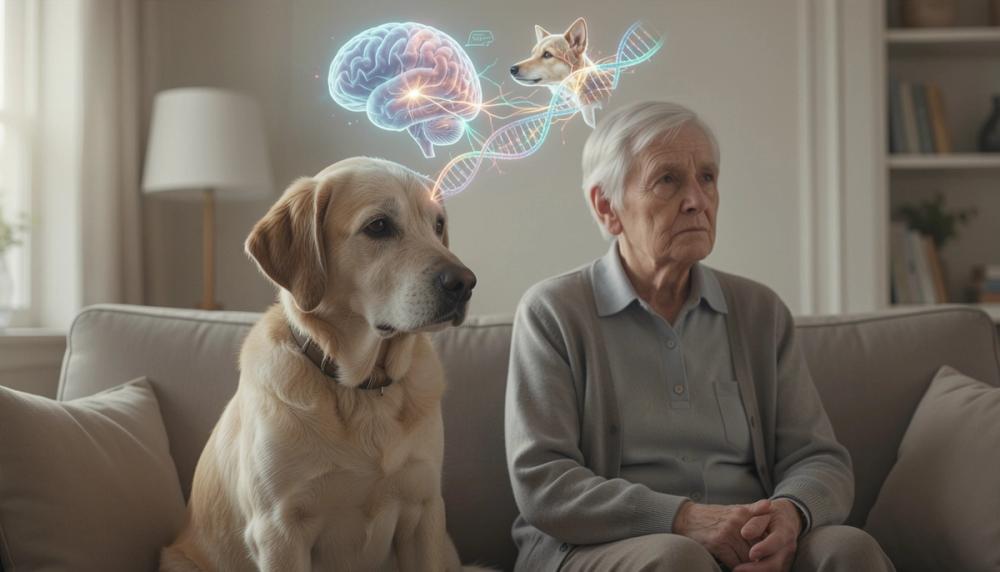
We tend to think of dementia as a uniquely human condition.It isn’t. Aging dogs can develop a neurodegenerative disorder known as Canine Cognitive Dysfunction (CCD), a condition that closely resembles Alzheimer’s disease in both symptoms and underlying biology.
And here’s the fascinating part: while dogs suffer from dementia, they may also help us understand, and even combat it. Because dogs don’t just suffer from dementia. They may be helping us decode it. Keep on and find out with MCI and Beyond how this works.
A Shared Biology of Decline
CCD is not a laboratory curiosity. It is a naturally occurring disease in aging dogs, marked by confusion, behavioral changes, and memory loss symptoms strikingly similar to human dementia.
But the parallel goes deeper.
Dogs, like humans, accumulate beta-amyloid plaques in the brain as they age—one of the hallmarks of Alzheimer’s pathology. (PubMed)
Large-scale research from the Dog Aging Project confirms that cognitive decline increases significantly with age, with the risk rising year after year. (PMC)
Even more revealing: this condition emerges naturally, not artificially induced in a lab. That makes dogs something rare in science, a real-world model of brain aging.
Why Dogs May Be Better Than Mice
For decades, dementia research has relied heavily on rodents. But mice don’t live like us. Dogs do.
They share our homes, routines, diets, pollutants, stressors, and even emotional environments. This makes them uniquely valuable for studying how lifestyle and environment shape brain aging.
The Dog Aging Project follows thousands of dogs over time, tracking cognition, health, and behavior in a way that mirrors long-term human studies.
And because dogs age faster, researchers can observe decades of human-like aging in just a few years.
This compresses time, and, of course, accelerates discovery.
The Other Side: How Dogs Help Humans Today
While science looks to dogs for answers, patients already benefit from them.
Interaction with dogs, especially therapy animals, has been associated with:
- Reduced anxiety and agitation
- Improved emotional regulation
- Increased social engagement
- Activation of preserved emotional memory pathways
In dementia care, where memory fades, but emotion often remains, this connection is powerful. Dogs don’t rely on language. They rely on presence.
A Two-Way Model of Care and Discovery
This is not a one-directional relationship.
It’s a feedback loop:
- Dogs help us understand how dementia develops
- Humans improve how we detect and manage CCD
- Both benefit from advances in diagnostics, lifestyle interventions, and potentially AI-driven tools
The Dog Aging Project’s Brain Health Study is explicitly designed to explore these shared mechanisms, aiming to improve outcomes for both species.
Why This Matters (Especially Now)
We are entering a world where dementia is no longer rare. And neither is longevity.
Understanding how brains age in real environments, not controlled cages, may be one of the most important scientific challenges of our time.
Dogs offer something unique:
- A faster biological clock
- A shared ecosystem
- A naturally occurring disease model
They are not just companions. They are co-travelers in aging.
Conclusion
You know what. There is something profoundly symbolic here.
As humans search for answers to cognitive decline, we may find them not only in laboratories, but beside us, quietly aging, observing, and reflecting our own biology back to us.
Dogs may forget, just like we do. But in helping us understand why, they may help us remember what matters most.
In short, understanding dementia in dogs may accelerate breakthroughs in human medicine faster than traditional models allow. It also reinforces a broader vision: that health, aging, and cognition are interconnected across species.
For communities with limited access to healthcare, this kind of research could lead to affordable, scalable solutions from early screening apps to low-cost behavioral interventions.
References
- Dog Aging Project
- Yarborough et al. (2022). Scientific Reports (PMC)
- Cotman et al. (2002). Neurobiology of Aging (PubMed)
- Dog Aging Project – Brain Health Study (dogagingproject.zendesk.com)
Share this message and sign up for our MCI and Beyond bi-weekly newsletter, featuring important resources and information for dementia caregivers.
#DementiaAwareness #AlzheimersResearch #DogAgingProject #BrainHealth #Neuroscience #AgingResearch #CognitiveDecline #DementiaCare #LongevityScience #MCIandBeyond
Sign up for our newsletter!
Get the latest information and inspirational stories for caregivers, delivered directly to your inbox.
