Updated on July 27, 2026
Editor: Marco Aurélio Gomes Veado

Stem Cells and Neurodegenerative Diseases: Is It Possible to Regenerate the Brain?
Marco Aurélio Gomes Veado
3 min read
•
August 20, 2026
Listen to audio version of this article
0:00
0:00
For decades, the idea of using stem cells to repair a damaged brain sounded more like science fiction than medicine.
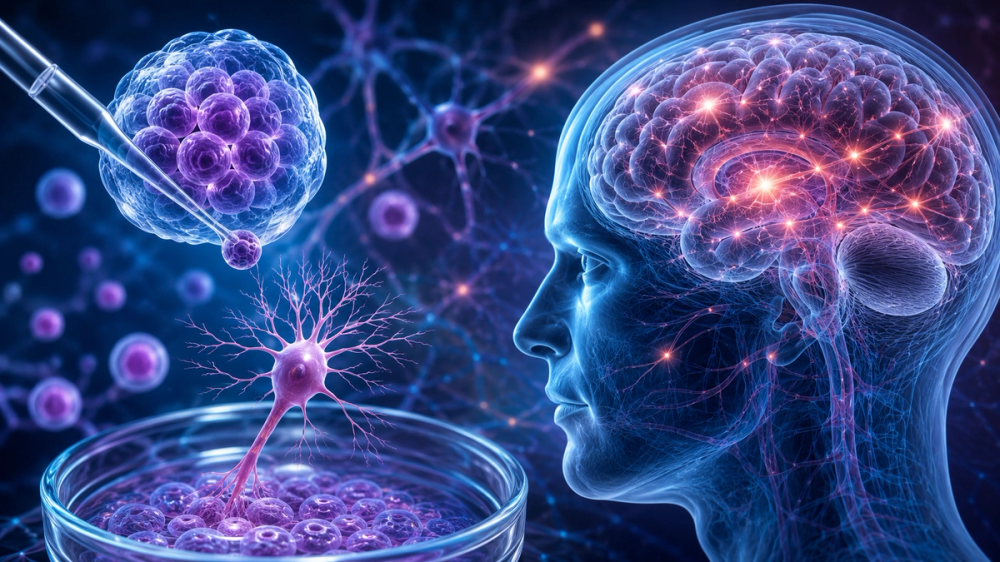
Today, that picture is changing. Researchers are learning how to create specialized human neurons from stem cells and, in some cases, transplant them into patients.
But how effective are stem cells really for Alzheimer’s disease, Parkinson’s disease, and other neurological conditions? The answer is encouraging, but very different depending on the disease.
MCI and Beyond is deep-diving now on this discovery and will let you know what’s going on with this fascinating research.
Parkinson’s: The Most Promising Example
Parkinson’s disease may currently be the strongest candidate for regenerative cell therapy.
One reason is that Parkinson’s involves the progressive loss of dopamine-producing neurons. Researchers can now create dopamine-producing progenitor cells from pluripotent stem cells and transplant them into the brain.
Recent clinical trials have produced particularly encouraging results.
Researchers have demonstrated that transplanted dopamine-producing cells can survive in the human brain and produce dopamine, with early studies reporting encouraging motor outcomes. However, these are still relatively small early-stage trials, and researchers need longer follow-up and larger randomized studies before the treatment can become routine care.
The significance is nevertheless considerable: we are no longer simply imagining the replacement of lost brain cells; we are beginning to demonstrate that it can be done in humans.
Alzheimer’s: A Much More Difficult Challenge
Alzheimer’s disease is considerably more complicated.
The disease involves amyloid plaques, tau pathology, inflammation, vascular changes, synaptic dysfunction, and widespread neuronal damage. Simply replacing one population of neurons may therefore not be enough.
Researchers are exploring several possibilities. Stem cells might replace damaged cells, but they may also act indirectly by releasing molecules that support surviving neurons, modulate inflammation, and modify the behavior of microglia, the brain’s immune cells.
Clinical evidence, however, remains preliminary.
A systematic review of cell-based treatments for Alzheimer’s identified only five clinical studies involving 70 people, highlighting just how early the field remains.
At the same time, research is becoming more sophisticated. A 2026 systematic review and meta-analysis of mesenchymal stem-cell studies in Alzheimer’s models found evidence suggesting effects on neuroinflammation, oxidative stress, amyloid-related processes, and other mechanisms. But these findings are largely preclinical and should not be confused with proof of effectiveness in people.
So, for Alzheimer’s, stem-cell therapy remains experimental rather than an established treatment.
What About Other Diseases?
Researchers are also investigating stem-cell approaches for Huntington’s disease, ALS, multiple sclerosis, stroke, spinal-cord injury, and retinal degeneration.
The potential mechanisms differ. In some diseases, the goal is to replace lost cells. In others, the objective may be to reduce inflammation, protect surviving neurons, or create an environment that encourages the nervous system to repair itself.
This distinction is crucial.
Regenerative medicine does not always mean replacing a dead cell with a new one. Sometimes it means helping the brain protect, repair, and reorganize itself.
The Future: Regeneration Plus Protection
For MCI and early Alzheimer’s, perhaps the most interesting future strategy will not be stem cells alone.
Imagine combining early diagnosis and biomarkers with treatments that reduce abnormal proteins, control inflammation, protect neurons, improve vascular health, and—when appropriate use regenerative cell therapies to repair some of the damage.
That could eventually produce a much more comprehensive approach to neurodegenerative disease.
But caution is essential. Stem-cell science is advancing rapidly, while commercial claims can move even faster. The U.S. FDA warns that many regenerative products marketed directly to patients have not been demonstrated to be safe or effective, and unapproved products have been associated with serious complications.
Conclusion
Parkinson’s has entered a remarkably promising era of cell replacement. Alzheimer’s is further behind, but researchers are exploring increasingly sophisticated ways to use stem cells and their biological signals.
We are not yet at the point of “regenerating the brain.”
But for the first time, parts of that idea are becoming scientifically plausible, and, in Parkinson’s research, increasingly demonstrable in humans.
Share and subscribe to receive the MCI and Beyond newsletter directly in your inbox.
References
- Feizi H, et al. A systematic review of clinical efficacy and safety of cell-based therapies in Alzheimer's disease. Dementia & Neuropsychologia, 2024. PubMed — Alzheimer’s stem-cell systematic review
- Kariminejad-Farsangi H, et al. Mechanistic insights into mesenchymal stem cell therapy for cognitive impairments in Alzheimer's disease models: a systematic review and meta-analysis. Molecular and Cellular Biochemistry, 2026. PubMed — 2026 systematic review and meta-analysis
- U.S. Food and Drug Administration. Consumer Alert on Regenerative Medicine Products Including Stem Cells and Exosomes. FDA — Regenerative Medicine Consumer Alert
- U.S. Food and Drug Administration. Important Patient and Consumer Information About Regenerative Medicine Therapies. FDA — Regenerative Medicine Information
#StemCells #StemCellTherapy #Alzheimers #Parkinsons #Dementia #MCI #Neuroscience #RegenerativeMedicine #BrainHealth #MCIandBeyond
Sign up for our newsletter!
Get the latest information and inspirational stories for caregivers, delivered directly to your inbox.
